
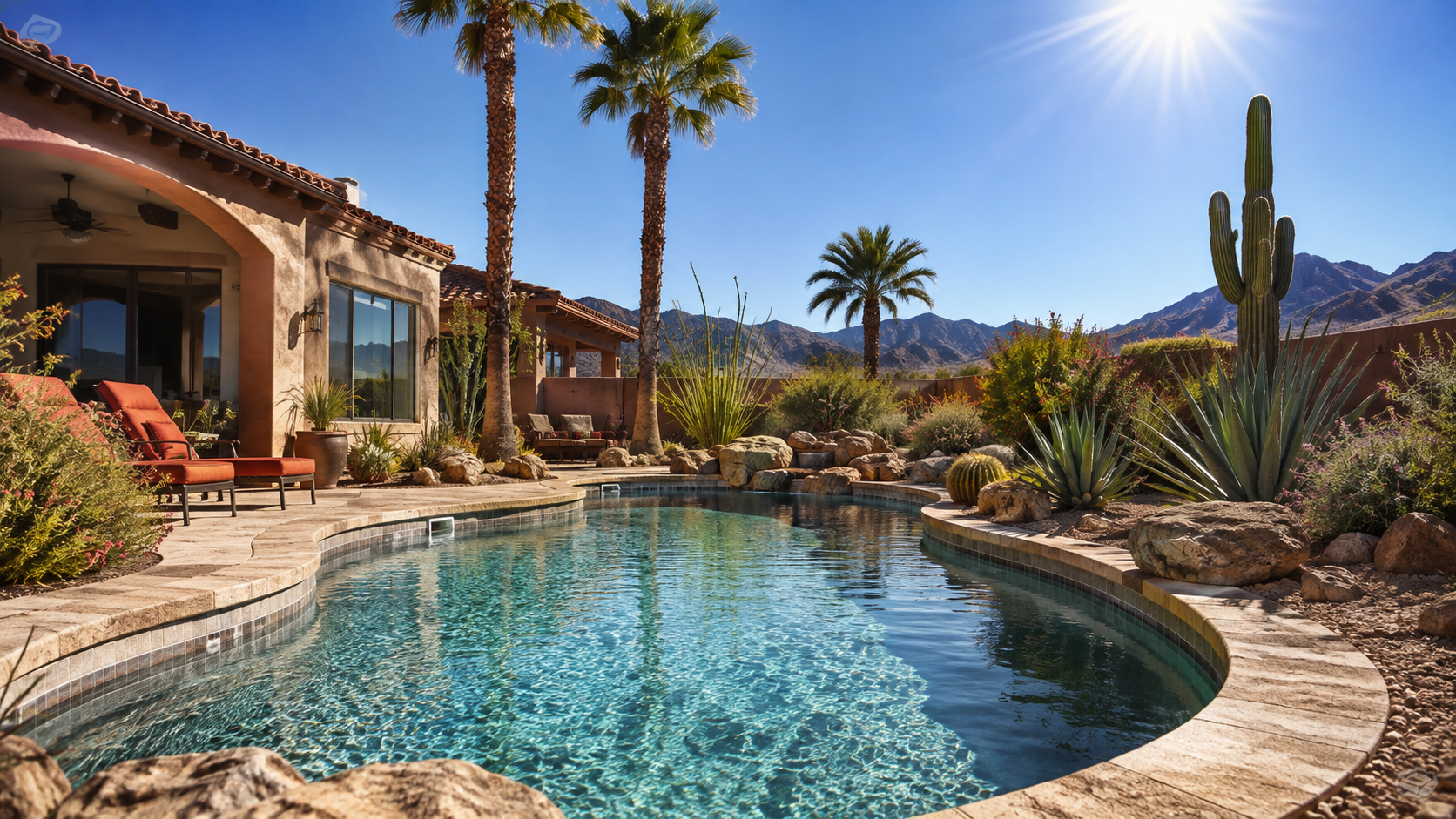
An Arizona swimming pool can look perfect in the morning and start developing problems surprisingly quickly during the hottest part of summer.
Intense sunlight, triple-digit temperatures, evaporation, dust, monsoon debris, and heavy pool use all put additional pressure on your water chemistry and circulation system. Chlorine can disappear faster, water levels can fall, algae can gain a foothold, and pumps and filters may need to work harder to keep the pool clear.
That makes August an especially important month to pay attention to small changes.
If your pool suddenly looks cloudy, needs more chlorine than usual, loses water quickly, or seems to require longer equipment runtimes, don’t automatically assume it is just normal Arizona summer behavior.
Here are the warning signs to watch for and the simple checks homeowners can perform before a small pool problem becomes a bigger one.
1. Your Chlorine Level Keeps Dropping Quickly
One of the first signs that Arizona heat is affecting your pool is chlorine that seems to disappear faster than expected.
Chlorine helps sanitize pool water, but intense ultraviolet sunlight can break it down. Hot weather, swimmers, organic debris, dust, and algae can create additional chlorine demand.
AZ Valley Pools notes that chlorine levels can fall faster in Arizona heat and recommends more frequent testing during hot conditions. (azvalleypools.com)
What homeowners can check
Test your chlorine regularly and compare the results from one day to the next.
Watch for a pattern where you add chlorine but the level quickly falls again.
Also look for:
- Cloudy water
- Slippery pool walls
- Green discoloration
- Strong changes in water clarity
- Heavy swimmer use
- Leaves or organic debris in the water
Rapid chlorine loss doesn’t automatically mean your equipment is failing.
However, if chlorine repeatedly disappears despite proper treatment and normal pool use, your overall water balance should be evaluated.
2. The Pool Water Looks Cloudy
Clear water is one of the easiest visual indicators of how well a pool is behaving.
If your water suddenly becomes hazy, dull, or cloudy, something has changed.
Potential contributors include:
- Low sanitizer levels
- Improper pH
- Poor filtration
- Heavy swimmer use
- Dust or storm debris
- Algae beginning to develop
- A dirty filter
- Circulation problems
AZ Valley Pools identifies cloudy or murky water as one potential sign that a pool filter needs attention. (azvalleypools.com)
Perform a simple clarity check
Stand at one end of the pool and look toward the deepest section.
Can you clearly see:
- The drain?
- Floor details?
- Pool fittings?
- Steps?
If visibility is noticeably worse than it was a few days ago, test the water instead of simply adding chemicals at random.
Cloudiness is a symptom. The goal is to determine what is causing it.
3. You Are Starting to See Algae
Arizona summer conditions can create an excellent environment for algae when sanitizer or circulation falls behind.
Early algae growth may not immediately turn the entire pool bright green.
Instead, you might first notice:
- Green patches in corners
- Discoloration along steps
- Slippery walls
- Growth around ladders
- Algae near low-circulation areas
- Green or yellow material along tile or grout
Brush questionable areas.
If the discoloration returns quickly, algae may be developing.
Why August matters
Warm water and strong sunlight can increase the challenge of maintaining proper pool chemistry. Dust and debris from monsoon storms can add another layer of stress.
AZ Valley Pools recommends consistent cleaning and water-balance monitoring for Arizona pools because high temperatures, intense sun, and dust can affect pool performance and water quality. (azvalleypools.com)
4. Your Pool Water Level Is Falling Faster Than Expected
All outdoor pools lose water through evaporation.
Arizona pools can lose a noticeable amount during hot, dry, windy weather.
That means a falling water level does not automatically mean you have a leak.
But you should pay attention when the loss seems dramatically different from normal.
Look for changes in the pattern
Ask yourself:
- Am I adding water much more often than usual?
- Has the autofill started running constantly?
- Did the water level drop significantly overnight?
- Is there wet soil near pool plumbing or equipment?
- Are there unexplained wet areas around the pool deck?
- Does the pool lose water even during relatively calm weather?
If the rate of water loss suddenly changes, a leak may be worth investigating.
Also inspect the pool autofill if you have one. An automatic filling system can mask water loss by continuously replacing what escapes.
5. Your Chemical Readings Are Suddenly Unusual
Pool chemistry is interconnected.
When one measurement moves significantly out of range, it can affect how other chemicals behave.
Homeowners commonly monitor measurements such as:
- Free chlorine
- pH
- Total alkalinity
- Calcium hardness
- Cyanuric acid or stabilizer
AZ Valley Pools’ Arizona pool-maintenance guidance emphasizes monitoring chlorine, pH, alkalinity, calcium hardness, and stabilizer because heat, sunlight, hard water, and evaporation can affect pool chemistry. (azvalleypools.com)
Watch for sudden changes
A reading that is slightly different from last week may not be concerning.
But pay attention when:
- Chlorine repeatedly crashes
- pH changes rapidly
- Readings refuse to stabilize
- Scale begins appearing
- Water becomes cloudy despite treatment
- You have to keep adding unusually large amounts of chemicals
When chemistry constantly swings back out of balance, there may be an underlying issue with circulation, filtration, water source, dosing, or pool maintenance.
6. Your Pump Is Running Longer Than It Used To
Pool pumps often need substantial runtime during Arizona summers.
Longer days, high temperatures, increased swimming, and more debris can all increase filtration demands.
However, a pump that suddenly needs much longer to maintain the same water quality deserves attention.
Listen and watch for changes such as:
- Longer filtration cycles
- Weak flow from return jets
- Air bubbles in the system
- Unusual pump noises
- Difficulty maintaining prime
- Increasing filter pressure
- Reduced skimmer suction
The problem may not be the pump itself.
A dirty filter, clogged basket, blocked line, air leak, or circulation problem can all make the system work harder.
7. The Filter Pressure Is Higher Than Normal
Get familiar with the normal operating pressure on your pool’s filter gauge.
That baseline is more valuable than simply memorizing a universal pressure number because every system is different.
If pressure rises noticeably above the normal clean-filter reading, the filter may be collecting enough debris to restrict flow.
AZ Valley Pools lists increased filter pressure, reduced return flow, cloudy water, and visible debris as signs that a filter may need cleaning. (azvalleypools.com)
This is particularly relevant after:
- Dust storms
- Monsoon winds
- Heavy swimming
- Landscaping work
- Large amounts of debris entering the pool
Do not ignore pressure changes or attempt to open pressurized pool equipment without knowing the proper shutdown procedure.
8. Water Flow From the Pool Jets Feels Weak
Your return jets provide another easy circulation check.
When the pool is operating normally, become familiar with how strong the return flow feels.
If it suddenly becomes much weaker, investigate.
Possible causes include:
- Dirty filter
- Clogged skimmer basket
- Full pump basket
- Blocked plumbing
- Pump problems
- Air entering the system
Weak circulation can create areas where water is not being filtered and treated as effectively.
That can contribute to cloudy water and algae even if you’re adding the right chemicals.
9. You Are Adding Chemicals Constantly Without Getting Results
Pool chemistry sometimes needs adjustment.
But repeatedly adding product without getting stable results is different.
If you find yourself treating the pool every day while the same problem keeps returning, stop guessing.
For example:
You add chlorine, but it disappears.
You adjust pH, but the reading swings again.
You treat cloudy water, but the pool never clears.
You brush algae, but it returns within days.
At that point, the issue may involve more than one chemical reading.
A complete water test combined with an equipment and circulation inspection can be much more useful than continuing to add chemicals one at a time.
AZ Valley Pools recommends regular pool-water testing and additional testing after heavy pool use or significant weather events. (azvalleypools.com)
A Simple August Arizona Pool Check
You don’t need to be a pool technician to perform a useful inspection.
During August, take a few minutes several times a week to check the following.
Look at the water
It should appear clear rather than cloudy, green, or dull.
Test the chemistry
Check sanitizer and pH regularly and monitor the other measurements recommended for your particular pool system.
Check the water level
Learn what normal evaporation looks like for your pool and watch for sudden changes.
Empty baskets
Inspect skimmer and pump baskets so debris doesn’t restrict circulation.
Check the return jets
Make sure water flow feels normal.
Look at the filter gauge
Know your system’s normal clean-filter pressure and watch for significant changes.
Walk around the equipment
Look for:
- Drips
- Wet concrete
- Unusual noises
- Air bubbles
- Loose connections
- Equipment that runs differently than normal
Brush the pool
Pay particular attention to steps, corners, walls, and areas with weaker circulation.
This simple routine can help you notice changes while they are still manageable.
Don’t Forget the Pool After an Arizona Monsoon
August isn’t only hot.
It’s also part of Arizona’s monsoon season.
Wind can push enormous amounts of dust, leaves, pollen, and debris into the pool.
After a significant storm:
- Remove large debris
- Empty baskets
- Check the filter
- Test the water
- Brush walls and steps
- Check chlorine
- Inspect the equipment area
- Look for unusual water levels
AZ Valley Pools has a dedicated guide to preparing your pool for Arizona’s monsoon season with additional seasonal maintenance considerations.
When Is It More Than Normal Summer Pool Maintenance?
Some changes are normal during August.
You may need to test more frequently.
The pool may need additional chlorine.
The water level may fall faster because of evaporation.
The filter may collect more dust.
The pump may run longer.
What matters is whether the pool responds normally when you address those conditions.
Consider professional pool service when:
- Chlorine repeatedly falls to very low levels
- Algae returns soon after treatment
- Water remains cloudy despite balanced chemistry
- The pool loses water unusually quickly
- Filter pressure remains abnormal after cleaning
- Return flow stays weak
- The pump loses prime repeatedly
- Equipment makes new or unusual noises
- You find persistent leaks around equipment
- Chemical readings are difficult to stabilize
- Equipment runtime keeps increasing without improving water quality
Those warning signs can point to a larger chemistry, filtration, circulation, or equipment issue.
Water Chemistry Problem or Equipment Problem?
Sometimes the hardest question is determining whether the water itself is out of balance or whether the equipment isn’t doing its job.
Signs pointing more toward chemistry
You may be dealing primarily with water balance when:
- Chlorine is consistently low
- pH is outside the desired range
- Algae develops
- Scale begins forming
- Water becomes cloudy after heavy swimming
- Problems improve after proper chemical adjustment
Signs pointing more toward equipment
Equipment deserves closer attention when:
- Return flow is weak
- Filter pressure is abnormal
- The pump will not maintain prime
- Air enters the return lines
- The equipment leaks
- The pump sounds different
- Circulation appears uneven
- Water problems return even when testing shows appropriate chemistry
Sometimes both issues occur at the same time.
Poor circulation can make it harder to maintain good water quality, while badly balanced water can contribute to scale and equipment problems.
Why Arizona Pools Need Extra Attention in August
August creates several challenges at once.
You have:
Intense sunlight that can increase chlorine loss.
High water temperatures that make maintaining sanitation especially important.
Evaporation that lowers the pool level and concentrates dissolved minerals.
Monsoon dust and debris that increase filtration demands.
Heavy swimming that adds additional contaminants.
That combination is why consistency matters more than waiting for the water to visibly turn green.
AZ Valley Pools’ maintenance guidance specifically emphasizes water balance and equipment inspection for pools exposed to Arizona’s hot, dry conditions.
Get Arizona Pool Help From AZ Valley Pools
If your pool is becoming harder to keep clear, chlorine is disappearing unusually quickly, algae keeps returning, or your equipment seems to be working harder than normal, an experienced pool professional can help determine whether the problem is water chemistry, filtration, circulation, equipment, or a combination of issues.
AZ Valley Pools offers pool construction, pool cleaning and maintenance, equipment-related services, and complete backyard projects designed for Arizona conditions. The company is licensed, bonded, and insured under ROC #322983.
Learn more about AZ Valley Pools’ pool cleaning and maintenance services or visit the official AZ Valley Pools website.
You can also view the AZ Valley Pools profile on House Pros Now to learn more about the company.
For additional Arizona homeowner guides and local service information, browse the House Pros Now blog.
AZ Valley Pools
Phone: (480) 397-2530
Email: info@azvalleypools.com
Location: Chandler, Arizona
Arizona ROC: #322983