
If you live in Gilbert or elsewhere in Arizona’s East Valley, you’ve probably seen the evidence of hard water even if you didn’t realize what was causing it.
White crust around a faucet. Spots that keep returning on shower glass. Dishes that look cloudy after coming out of the dishwasher. Laundry that doesn’t feel quite as soft as expected.
Hard water contains dissolved minerals, particularly calcium and magnesium. While hard water itself isn’t usually an emergency, those minerals can leave deposits throughout your home and make everyday cleaning, plumbing, fixtures, and water-using appliances more frustrating.
So how can you tell whether hard water is affecting your home?
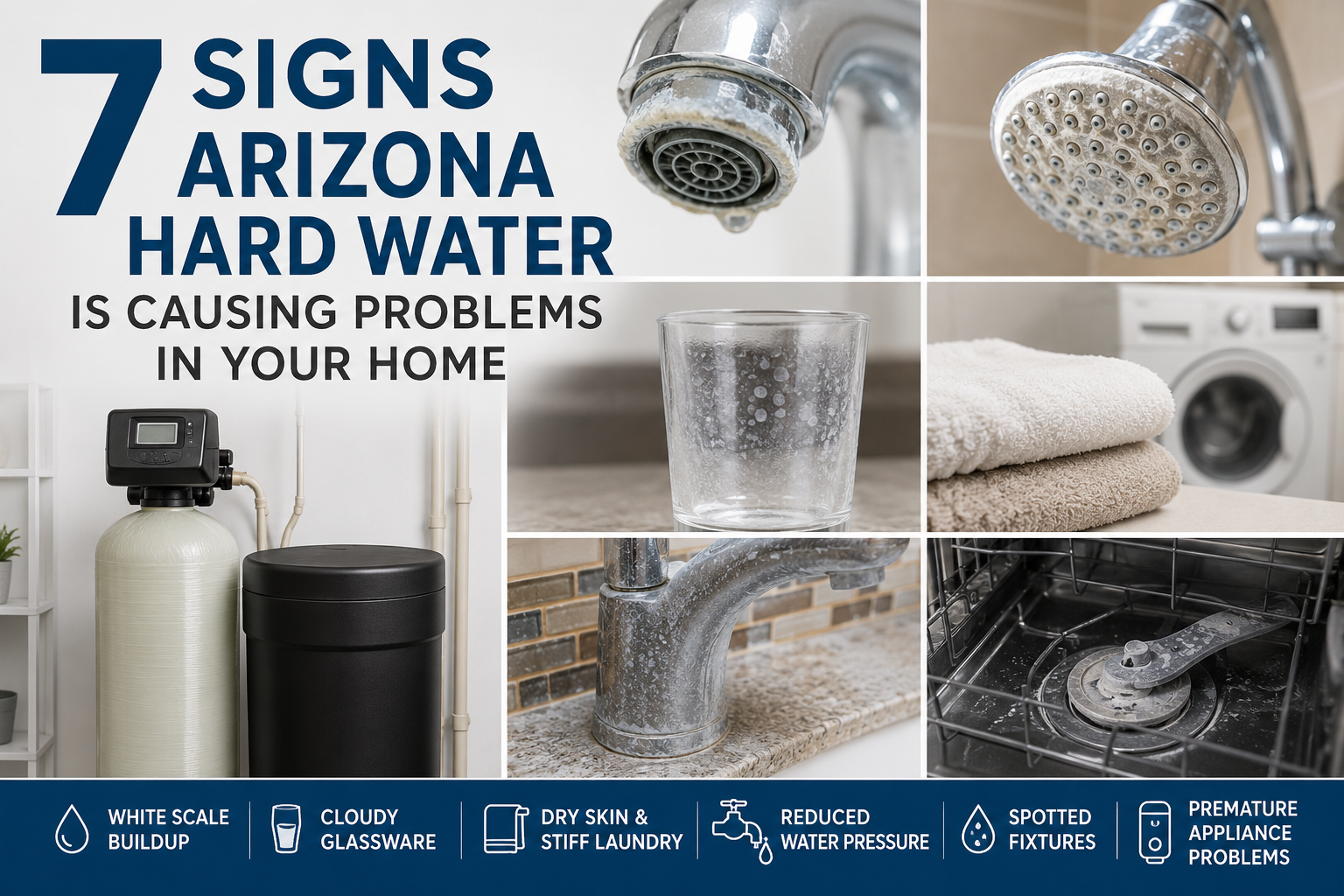
Here are seven common warning signs Arizona homeowners should watch for.
1. White Scale Keeps Building Up Around Faucets and Fixtures
One of the easiest signs of hard water to recognize is the chalky white material that appears around faucets, showerheads, sink drains, and other places where water regularly evaporates.
This buildup is commonly called scale or limescale.
You may notice it around:
- Faucet aerators
- Showerheads
- Sink edges
- Tub fixtures
- Glass shower doors
- Toilet bowls
- Plumbing connections
You may clean it away only to see it return a short time later.
That’s because cleaning removes the deposits you can see, but it doesn’t change the mineral content of the water creating them.
If scale seems to be appearing throughout the house rather than around one isolated fixture, testing your water hardness can help determine whether the water supply itself is contributing to the problem.
Gilbert Water Softeners explains more about hard water in Gilbert, Arizona and how calcium and magnesium contribute to mineral buildup.
2. Your Glassware Comes Out Cloudy or Spotted
Have you ever emptied the dishwasher only to find that your glasses still look dirty?
Hard water can leave mineral residue behind as water droplets dry.
You might notice:
- White spots on drinking glasses
- Cloudy-looking glassware
- Spots on silverware
- Film on dishes
- White residue inside the dishwasher
Sometimes these deposits can be wiped or cleaned away. Other times, repeated exposure can make glassware increasingly difficult to keep clear.
Try this simple check
Inspect a freshly washed glass under bright light.
If you see a pattern of white spots where water droplets dried, mineral-rich water may be contributing.
You can also look at the inside walls, racks, and heating area of your dishwasher for similar white or chalky buildup.
3. Your Skin Feels Dry After Showering
Hard water doesn’t only leave residue on fixtures.
Some people notice that their skin feels dry, tight, or less comfortable after bathing in mineral-rich water. Hard water can also make soaps and shampoos feel as though they don’t rinse or lather the way you expect.
You may find yourself:
- Using more soap or shampoo
- Feeling residue after showering
- Dealing with dry-feeling skin
- Noticing dull or difficult-to-manage hair
- Cleaning soap scum from showers more frequently
These signs alone don’t prove that your water is hard, and persistent skin problems can have many causes.
But if dry-feeling skin occurs alongside obvious scale, spotted fixtures, and cloudy dishes, it adds another clue.
Gilbert Water Softeners specifically lists reduced spotting, less buildup, and improvements in the feel of water used for bathing and laundry among the reasons homeowners consider water softening and filtration systems.
4. Towels and Laundry Feel Stiff or Dull
Your washing machine may also reveal hard-water problems.
Minerals in hard water can interfere with how effectively soaps and detergents perform.
As a result, you may notice:
- Towels that feel stiff
- Clothes that feel rough after washing
- Whites that look dull
- Laundry that doesn’t seem completely clean
- More detergent needed to get satisfactory results
Before assuming the washing machine itself is failing, look for other hard-water clues around the house.
If your faucets have scale, your shower glass is constantly spotted, and your laundry also feels unusually stiff, the same water-quality issue could be affecting several areas of your home.
For more information about the company and its water-treatment services, House Pros Now has also featured Gilbert Water Softeners and its East Valley services.
5. Your Faucets or Showerheads Seem to Have Lower Water Pressure
Reduced water pressure can have many causes, so it shouldn’t automatically be blamed on hard water.
However, mineral buildup can gradually restrict small openings.
This is especially easy to see on showerheads and faucet aerators.
Check your faucet aerators
Unscrew the aerator from the end of a faucet if it is designed to be safely removed.
Look for:
- White mineral deposits
- Partially blocked openings
- Crust around the screen
- Uneven water flow
You can perform a similar visual inspection of your showerhead.
If individual fixtures have weak or uneven flow while pressure elsewhere in the home seems normal, mineral buildup at the fixture may be part of the problem.
Widespread or sudden pressure loss, however, should be investigated separately because leaks, valves, pressure regulators, and other plumbing issues can cause similar symptoms.
6. You Constantly See Spots on Faucets, Sinks, and Shower Glass
You wipe down the bathroom.
Everything looks great.
Then the water dries and the spots come right back.
Sound familiar?
Persistent spotting is one of the most visible annoyances associated with hard water.
You’ll often notice it on:
- Chrome faucets
- Stainless steel sinks
- Shower glass
- Mirrors near sinks
- Tile
- Countertops around faucets
- Bathroom fixtures
The spots appear as droplets evaporate and leave dissolved minerals behind.
In an Arizona home with noticeably hard water, homeowners may spend a surprising amount of time cleaning the same mineral deposits over and over.
If you are constantly fighting white spots and crusty buildup throughout the home, it may be worth finding out exactly how hard your water is.
You can view the Gilbert Water Softeners profile on House Pros Now for more information about their services.
7. Water-Using Appliances Are Developing Scale or Problems Early
Hard water can affect more than the fixtures you see every day.
Any appliance that regularly heats, moves, or evaporates water can potentially collect mineral deposits over time.
That may include:
- Water heaters
- Dishwashers
- Washing machines
- Coffee makers
- Ice makers
- Humidifiers
- Other water-using equipment
Heating water can make mineral deposits especially noticeable.
If you’re seeing significant scale throughout the house and also experiencing recurring problems with water-using appliances, water hardness is worth considering as one possible contributing factor.
Gilbert Water Softeners also discusses the relationship between mineral buildup, plumbing, and water-using appliances in its guide to the benefits of installing a water softener.
Of course, appliance problems have many possible causes. Water testing can help determine whether hardness is significant enough to warrant treatment before you assume it is responsible for a specific failure.
How to Tell If You Really Have Hard Water
The warning signs around your home can point you in the right direction, but testing is the best way to understand your actual water hardness.
Before spending money on treatment, consider testing the water.
A hardness test can help determine how much dissolved calcium and magnesium is present and give you a better basis for comparing treatment options.
Start with a visual inspection
Walk through your kitchen, bathrooms, laundry area, and utility spaces.
Look for:
Faucets: White or crusty deposits.
Showerheads: Blocked spray openings or mineral scale.
Shower glass: Persistent white spotting.
Dishwasher: Cloudy residue or interior scale.
Laundry: Stiff-feeling towels and clothing.
Water heater area: Signs of scale or sediment concerns.
Fixtures: Mineral spots that return shortly after cleaning.
If several signs appear throughout the home, testing can help confirm whether hardness is the common factor.
When Is Water Testing Worth Considering?
You don’t have to wait until something breaks.
Testing may be worthwhile if:
- You’re seeing mineral buildup throughout the house
- Glassware is consistently cloudy or spotted
- Shower glass requires constant descaling
- Soap doesn’t seem to lather well
- Towels and clothing feel unusually stiff
- You’re considering buying a water softener
- You’ve recently moved into an Arizona home
- You don’t know whether an existing softener is working properly
Gilbert Water Softeners currently offers in-home water testing that evaluates water hardness along with other water-quality measurements. Their team serves Gilbert and surrounding East Valley communities including Mesa, Chandler, Queen Creek, and San Tan Valley.
Homeowners can contact Gilbert Water Softeners to ask about testing or treatment options.
Water Softener vs. Water Filtration: What’s the Difference?
These terms are often used interchangeably, but they don’t necessarily solve the same problem.
Water softeners
A traditional water softener is designed specifically to address hardness minerals such as calcium and magnesium.
For homeowners whose biggest complaints are:
- Scale
- Spots
- Hard-water residue
- Stiff laundry
- Mineral buildup
a softener may be the type of system worth evaluating.
Water filtration systems
Filtration systems are generally designed to reduce particular substances or improve other aspects of water quality.
The appropriate system depends on what you’re trying to address.
Reverse osmosis systems
Reverse osmosis systems are commonly used for drinking water treatment rather than simply treating hardness throughout the entire home.
Gilbert Water Softeners offers water softeners, whole-home filtration, salt-free conditioning options, and reverse osmosis systems, so testing the water first can help determine which type of treatment actually matches the problem.
You can learn more about their available water treatment options and packages.
Should Every Arizona Home Have a Water Softener?
Not necessarily.
Whether water treatment is worthwhile depends on your water, your preferences, your home’s plumbing and appliances, and how much the effects of hard water bother you.
Some homeowners are primarily concerned about appearance because they’re tired of cleaning spots from fixtures and shower glass.
Others want to reduce mineral buildup throughout the plumbing system or improve how water behaves when washing clothes and dishes.
The important thing is to identify the problem before buying the solution.
If you’re unsure, start with a water hardness test and compare your results with what you’re seeing around your home.
A Quick Arizona Hard-Water Checklist
Think your home may have hard water? Look for these seven signs:
1. White scale buildup
Check faucets, drains, showerheads, and sinks.
2. Cloudy glassware
Look for persistent white spots after dishwasher cycles.
3. Dry-feeling skin or hair
Notice how your skin feels after showering and how soaps perform.
4. Stiff laundry
Check towels and clothing after washing.
5. Reduced flow at fixtures
Inspect faucet aerators and showerheads for mineral blockage.
6. Constant spotting
Look at chrome fixtures, stainless steel, tile, and shower glass.
7. Appliance scale or recurring problems
Pay attention to equipment that regularly uses or heats water.
One symptom alone may have another explanation.
When several appear together, however, testing your water can help determine whether hardness is contributing.
Find Water Treatment Help in Gilbert, Arizona
Hard water is common enough in the East Valley that many homeowners simply get used to the white spots, crusty faucets, and endless shower-glass cleaning.
But those signs can tell you something useful about what’s happening with your home’s water.
If you’re seeing buildup throughout the house, a water test can help you understand your water before deciding whether a softener, filtration system, or other treatment makes sense.
For more Arizona homeowner tips and local service information, browse the House Pros Now blog.
House Pros Now has also featured Gilbert Water Softeners and its water-treatment services for Gilbert and East Valley homeowners.
Need Help With Hard Water in Gilbert?
Gilbert Water Softeners provides water softener installation, whole-home filtration, reverse osmosis systems, water testing, and related water-treatment services for Gilbert and surrounding East Valley communities.
Visit the official Gilbert Water Softeners website to learn more, contact Gilbert Water Softeners to ask about your home’s water, or view their House Pros Now business profile.
Gilbert Water Softeners
Phone: (480) 433-7069
Email: info@gilbertwatersofteners.com
Location: Gilbert, Arizona
Service Area: Gilbert and surrounding East Valley communities